Turbocharging has transformed modern engine design. What once required large displacement and heavy fuel consumption can now be achieved with smaller engines and forced induction. A turbocharger compresses incoming air, allowing more oxygen into the combustion chamber. More oxygen means more fuel can be burned, and that directly increases horsepower.
Many drivers considering performance upgrades often ask how much horsepower a turbo can actually add. The answer is not a single number. Gains depend on engine size, boost pressure, supporting modifications, and tuning.
In factory applications, a turbo may add 30 to 50 percent more power compared to a naturally aspirated version of the same engine. In modified setups, gains can be much higher. To fully appreciate the potential, it helps to understand how turbochargers work, what determines power increase, and what limits must be respected for reliability.
How A Turbocharger Increases Horsepower
Forced Induction And Air Density Explained
An engine produces power by mixing air and fuel inside its cylinders. Naturally aspirated engines rely on atmospheric pressure to fill the cylinders with air. A turbocharger changes that by compressing air before it enters the engine.
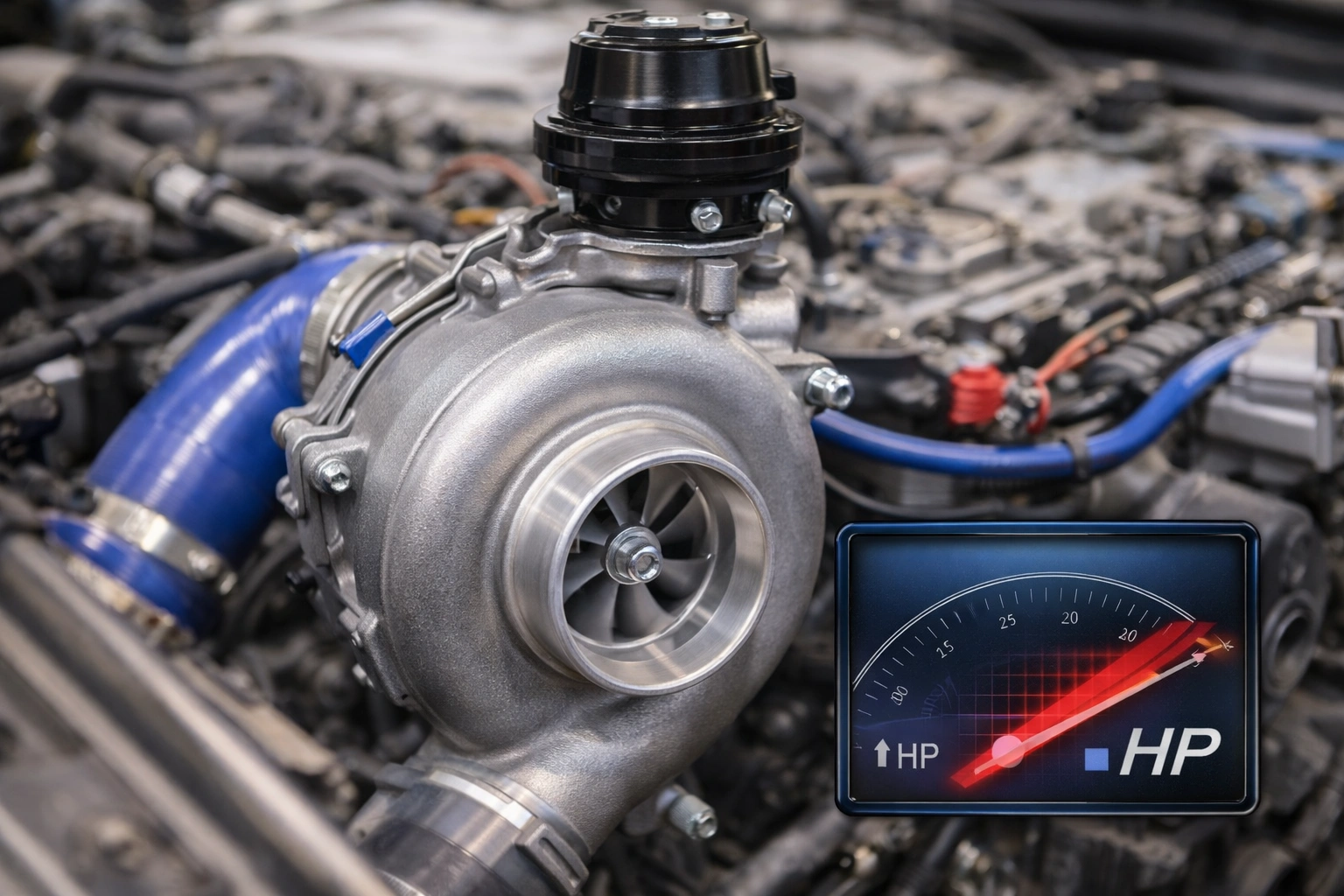
The turbo uses exhaust gases to spin a turbine wheel. That turbine connects to a compressor wheel, which forces more air into the intake system. When air density increases, more fuel can be added safely. The result is a stronger combustion event and higher output.
For example, the Ford Mustang EcoBoost uses a turbocharged four cylinder engine to produce power levels once associated with larger V6 engines. Without the turbo, the same displacement would generate significantly less horsepower.
The principle is simple: more air plus more fuel equals more power.
Boost Pressure And Its Impact On Power
Boost pressure refers to the additional air pressure created by the turbocharger above normal atmospheric levels. It is typically measured in pounds per square inch.
A basic rule often cited in performance circles suggests that each additional 7 pounds of boost can theoretically increase power by about 50 percent, assuming the engine and tuning support it. Real world gains vary, but this illustrates how significant forced induction can be.
Low boost factory setups often produce moderate increases for reliability. Higher boost aftermarket systems can double horsepower under the right conditions.
Proper tuning and engine strength determine how much boost can safely be applied.
Average Horsepower Gains From A Turbo
Factory Turbocharged Engine Comparisons
In factory form, turbocharged engines are designed to balance performance and longevity. Automakers carefully calibrate boost levels to maintain durability.
A naturally aspirated four cylinder engine producing 180 horsepower might increase to 240 or 260 horsepower with a turbo in factory trim. That represents roughly a 30 to 40 percent increase.
Vehicles such as the Volkswagen GTI rely on turbocharging to deliver strong output from compact engines. Without forced induction, achieving similar numbers would require larger displacement.
Factory turbo systems are conservative to protect internal components and maintain warranty reliability.
Aftermarket Turbo Installations
When installing an aftermarket turbo on a naturally aspirated engine, gains depend heavily on supporting modifications. On stock internals with low boost, horsepower may increase by 40 to 60 percent.
With forged pistons, upgraded fuel systems, and proper engine management tuning, gains can be much higher. Some builds double or even triple original output.
However, pushing extreme boost without upgrading components can lead to engine damage. Heat management, fuel delivery, and cooling systems must all be addressed.
Responsible tuning ensures sustainable power rather than short lived performance.
Factors That Influence Turbo Power Gains
Engine Strength And Compression Ratio
Not all engines respond equally to turbocharging. Compression ratio plays a major role. High compression engines may require lower boost to avoid detonation.
Strong internal components such as forged pistons and rods handle higher pressures more effectively. Engines originally designed for forced induction often include stronger internals from the factory.
The Subaru WRX is built with turbocharging in mind, allowing significant tuning potential compared to engines not originally designed for boost.
Choosing the right turbo size also affects how power builds across the rpm range.
Supporting Modifications And Tuning
Adding a turbo alone is not enough to maximize horsepower safely. Fuel injectors must supply adequate fuel. Intercoolers reduce intake air temperature, preventing power loss and engine knock.
Exhaust systems help reduce back pressure and improve turbo efficiency. Engine control units require recalibration to balance air and fuel mixtures correctly.
Without proper tuning, added boost may cause lean conditions or detonation, which can damage pistons and valves.
Every supporting component contributes to the final horsepower figure.
Reliability And Long Term Considerations
Turbochargers introduce additional heat and pressure into the engine system. Oil quality becomes even more important because the turbo relies on oil for lubrication and cooling.
Routine maintenance intervals may shorten in high performance builds. Cooling systems must function properly to handle added thermal stress.
Driving habits also affect longevity. Allowing the engine to warm up and cool down gradually protects turbo bearings and seals.
When installed and tuned correctly, a turbo can provide significant horsepower gains while maintaining reliability.
A turbocharger can add anywhere from 30 percent to well over 100 percent more horsepower depending on setup and engine capability. Factory systems deliver moderate increases designed for durability, while aftermarket builds can achieve dramatic gains with proper supporting modifications.
The key to successful turbocharging lies in balance. Boost pressure, engine strength, cooling, and tuning must work together. When done correctly, a turbo transforms engine output without increasing displacement, offering impressive power from a compact platform.