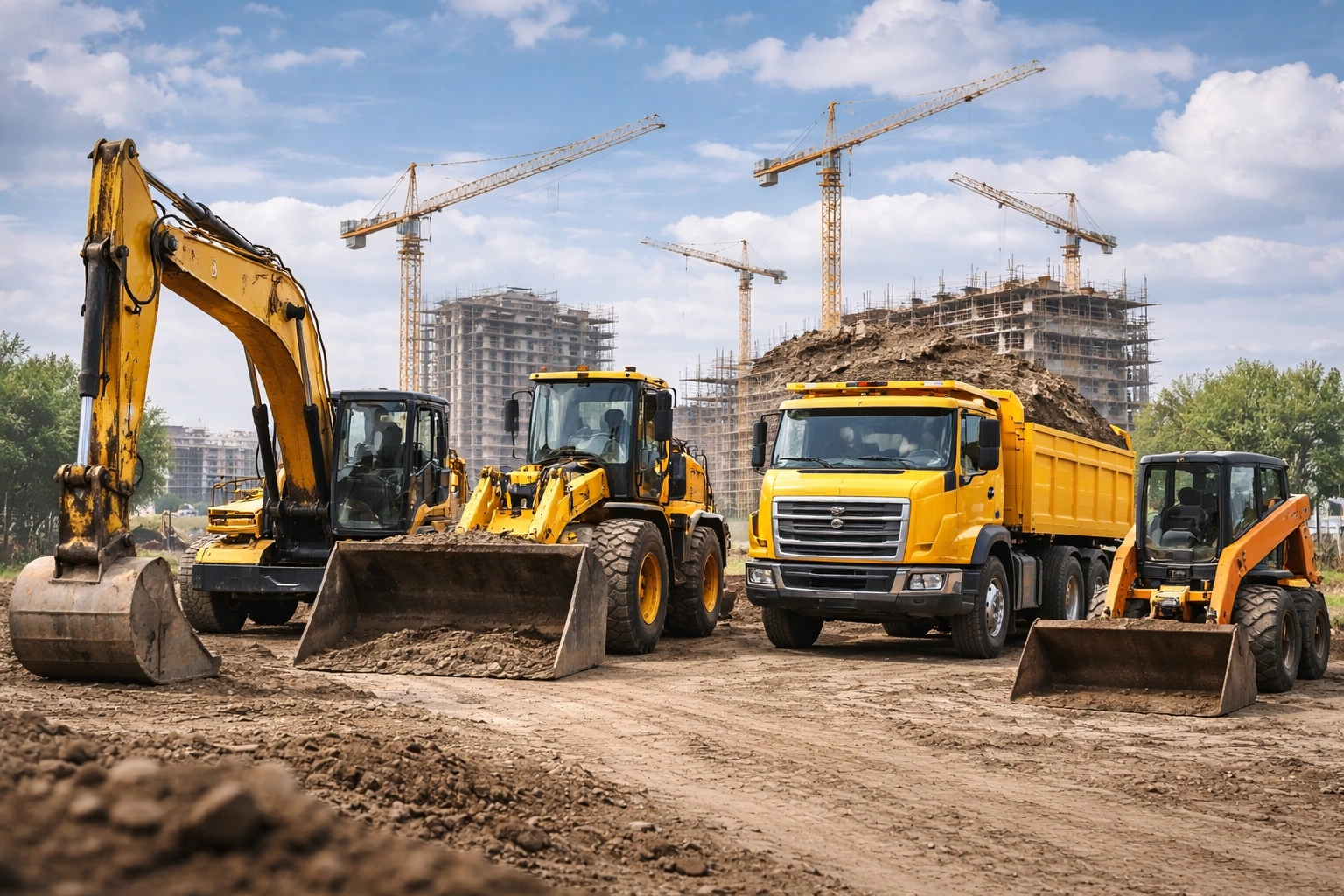
Construction projects rely on powerful machines built to move earth, lift heavy materials, and shape landscapes. From towering cranes to compact loaders, each vehicle serves a specific purpose.
These machines are engineered for durability, strength, and precision. Without them, large scale infrastructure such as highways, bridges, and buildings would take years longer to complete.
Construction vehicles vary in size and function depending on the job site. Some are designed for digging deep foundations, while others focus on transporting materials or compacting soil. Operators require training to handle these machines safely, as each one responds differently to terrain and load.
Selecting the correct vehicle improves efficiency, reduces labor costs, and enhances overall project safety. A closer look at the most common types reveals how each contributes to modern construction work.
Earth Moving Equipment Used For Digging And Grading
Excavators Designed For Heavy Digging
Caterpillar 320 Excavator
Komatsu PC210
Excavators are among the most recognizable construction machines. They feature a rotating cab mounted on tracks or wheels and a long hydraulic arm equipped with a bucket or attachment. Excavators handle tasks such as trenching, digging foundations, demolition, and material handling.
The rotating upper structure allows operators to swing materials efficiently without repositioning the entire machine. Attachments such as hydraulic breakers or grapples increase versatility. Tracked excavators provide stability on uneven ground, while wheeled versions move more easily on paved surfaces.
Their hydraulic systems deliver strong breakout force, making them ideal for heavy excavation projects. From small residential sites to large infrastructure developments, excavators play a central role in earth removal and site preparation.
Bulldozers Built For Pushing And Clearing
Caterpillar D6 Dozer
Komatsu D65
Bulldozers are powerful machines designed to push large quantities of soil, sand, and debris. They feature a wide front blade and heavy duty tracks that distribute weight evenly across rough terrain.
The blade angle and tilt can be adjusted to control material movement precisely. Bulldozers are commonly used for clearing land, leveling surfaces, and creating access roads.
Tracks provide strong traction, allowing them to operate effectively on mud, sand, or rocky terrain. Their simple yet durable design makes them reliable on demanding job sites where strength and traction matter most.
Material Handling And Lifting Equipment
Cranes Used For Vertical Lifting
Liebherr LTM 1100
Terex RT 555
Cranes are essential for lifting heavy materials to elevated positions. They vary in design, including mobile cranes, tower cranes, and rough terrain cranes.
Mobile cranes travel on roads and are ideal for short term projects. Tower cranes are fixed structures often seen on high rise construction sites. Rough terrain cranes handle uneven surfaces effectively.
Hydraulic systems and counterweights provide stability while lifting steel beams, concrete panels, or large equipment. Proper load calculation and operator training ensure safe lifting operations.
Cranes expand the vertical capabilities of construction sites, enabling efficient building assembly.
Forklifts And Telehandlers For Site Transport
JCB 540 Telehandler
Toyota 8FGU25
Forklifts and telehandlers focus on moving materials across job sites. Forklifts operate primarily on flat surfaces, lifting pallets and supplies.
Telehandlers extend outward and upward with a telescopic boom, offering greater reach and versatility. They are often used to lift materials to upper floors or across obstacles.
Both machines increase efficiency by reducing manual labor and improving material flow. Attachments such as buckets or lifting hooks enhance adaptability.
Reliable material handling equipment keeps projects organized and on schedule.
Road Construction And Surface Equipment
Motor Graders For Precision Leveling
Caterpillar 140 Motor Grader
John Deere 670G
Motor graders shape and level surfaces with high precision. They feature a long adjustable blade positioned between the front and rear axles.
Graders are commonly used in road construction to create smooth, even surfaces before paving. Their ability to control blade angle and height allows for accurate slope creation and drainage shaping.
Experienced operators achieve precise grading results, ensuring road durability and water management efficiency.
Motor graders play a vital role in preparing foundations for asphalt or concrete layers.
Asphalt Pavers And Rollers For Road Finishing
Volvo ABG P7820
Bomag BW 213
Asphalt pavers distribute hot asphalt evenly across prepared surfaces. They lay material at controlled thickness and width.
Rollers follow behind pavers to compact the surface, removing air pockets and increasing density. Proper compaction ensures long lasting pavement durability.
These machines work together to complete road construction efficiently. Their coordination determines the final surface quality and structural integrity.
Consistent operation produces smooth and durable roadways.
Specialized And Compact Construction Vehicles
Backhoe Loaders For Versatile Tasks
Caterpillar 420 Backhoe
JCB 3CX
Backhoe loaders combine a front loader bucket with a rear digging arm. This dual function design allows them to perform multiple tasks on smaller sites.
They are often used for trenching, lifting materials, and site cleanup. Their compact size makes them ideal for urban projects or residential construction.
Backhoes provide flexibility without requiring multiple machines, reducing equipment costs.
Their versatility makes them a staple on many construction sites.
Skid Steer Loaders For Tight Spaces
Bobcat S650
Case SR210
Skid steer loaders are compact machines designed for maneuverability. They use independent wheel control to turn within tight spaces.
Equipped with various attachments, skid steers can handle digging, lifting, grading, and even snow removal. Their small footprint allows operation in confined areas where larger machines cannot fit.
Despite their size, skid steers deliver impressive power for light to medium duty tasks.
They offer efficiency and adaptability on crowded job sites.
Construction vehicles serve specific roles in shaping landscapes and building infrastructure. Excavators and bulldozers move earth, cranes and forklifts handle heavy lifting, graders and pavers refine surfaces, and compact machines handle versatile tasks.
Each machine is engineered to meet the physical demands of construction environments. Choosing the correct equipment improves productivity, safety, and project timelines. Modern construction depends on these powerful vehicles to transform plans into finished structures efficiently and reliably.